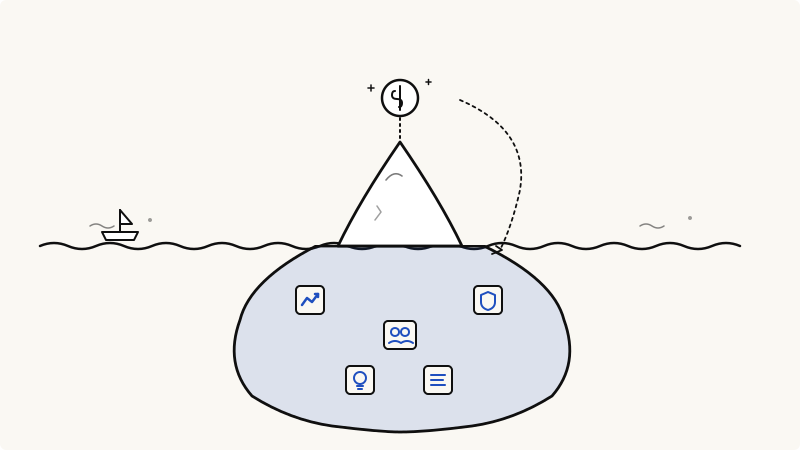
Most owners assume buyers pay for revenue or "the brand." They don't. They pay for certainty about future cash flow. Everything else is a derivative of that one idea.
We have had this conversation hundreds of times. An owner sits across the table, proud of the business they have built, and tells us about their reputation, their history, their market position. But when we ask them what a buyer will actually write a cheque for, the answer is usually vague. "The earnings." "The growth." "The brand we've built."
These are not wrong answers. They are incomplete. And in our experience advising on mid-market transactions (businesses typically in the $3 million to $50 million enterprise value range), incomplete understanding of value drivers leads to incomplete outcomes.
Buyers are purchasing a future income stream, not your past
Here is the shift that matters: a buyer is not paying for what your business has done. They are paying for what it will do after they own it. Your twenty-year history matters only insofar as it predicts the future.
A private equity fund deploying $15 million into your business needs to believe they can generate a return for their investors. A trade buyer needs to justify the acquisition to their board. Neither is buying sentiment. They are buying cash flow, risk-adjusted and discounted to present value.
Once you internalise this, you start to see your business through the buyer's eyes. And that shift in perspective is worth more than any valuation report.
The three things that actually move the multiple
We could list twenty value drivers. But in practice, three factors explain most of the gap between businesses that sell at the top of their multiple range and those that sell at the bottom.
Revenue quality. Not quantity. Quality. Recurring revenue that repeats without requiring a new sale each time is the most valuable form of income a business can generate. Subscriptions, retainers, maintenance contracts, managed services agreements. Contracted revenue (long-term supply agreements, multi-year service contracts) is the next tier. Project-based or transactional revenue, where every dollar requires a new proposal, sits at the bottom.
We regularly see this difference add a full turn of EBITDA to the multiple. A business generating $2 million in EBITDA from project work might sell at 3.5x. The same earnings from contracted recurring revenue might command 5x. That is a $3 million difference in enterprise value driven entirely by the nature of the revenue, not its size.
Customer diversification. If your largest customer represents more than 15 to 20 percent of revenue, buyers will discount. If your top three represent more than 50 percent, you have a structural problem that will either reduce your multiple, introduce an earn-out, or kill the deal.
The counterargument owners always make is: "They've been with us for fifteen years. They're not going anywhere." Maybe. But the buyer is not buying your relationship with that customer. They are buying the business after you leave. And the moment you leave, that relationship becomes uncertain in the buyer's model.
We have seen identical businesses in the same industry, with the same EBITDA and margins, sell with a $4 million gap in enterprise value because one had concentration risk and the other did not.
The management layer below the owner. If you are the person who holds the key customer relationships, makes all the important decisions, knows where everything is, and cannot take three weeks off without the business suffering, your business has a founder dependency problem. And buyers know it.
A business that relies on its owner is not really a transferable asset. It is a job dressed up as a business. Buyers either avoid it entirely, or they price it accordingly. Usually with a lower multiple and a longer, more painful earn-out.
A management team that has been in place for twelve to eighteen months, holds genuine decision-making authority, and can articulate the business strategy independently of the founder changes the entire complexion of a transaction. We tell owners: take a genuine four-week holiday and see what happens. If the business hums along, you are in good shape. If your phone rings constantly, you have work to do.
What buyers will not pay for
Understanding what buyers value is half the picture. The other half:
They will not pay for revenue that depends on you personally. They will not pay for intellectual property that has not been commercialised. They will not pay for your pipeline, your plans, or your ideas about what could be. Only for growth that has already been demonstrated. And they will not pay for the story of your business. Your founding myth, your legacy. These are not worthless, but they are not line items in an investment committee model.
The practical implication
If you step back and look at what buyers actually pay for (recurring revenue, diversified customers, management depth), a pattern emerges. These are all proxies for the same thing: confidence that the business will generate predictable cash flow without the current owner.
The good news is that all three are within your control. You cannot change your industry dynamics overnight. But you can convert transactional revenue to recurring, diversify your customer base, and build a management team. These are twelve-to-twenty-four-month projects, not overnight fixes.
And they also make your business better to own and run in the meantime. A business that is attractive to buyers is, by definition, a business that is less stressful, more profitable, and more resilient for its owner.
Build the business a buyer would want to own. The sale outcome will take care of itself.