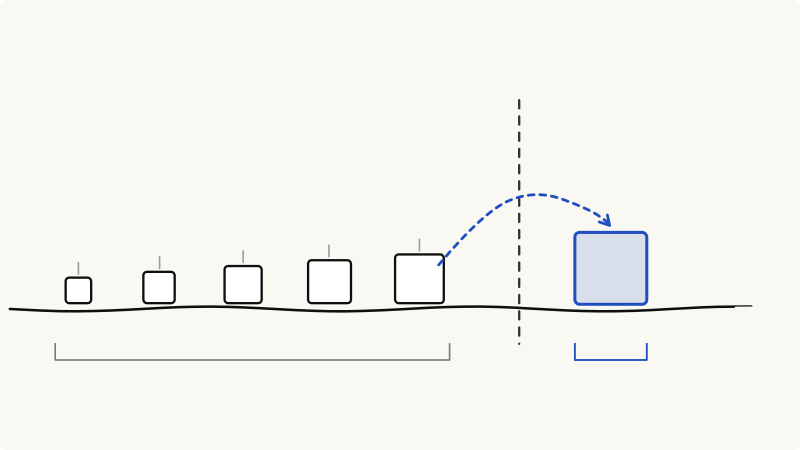
Australia's mandatory merger regime commenced on 1 January. The thresholds are large enough that most mid-market vendors read them once and conclude it has nothing to do with them. It reaches them anyway, through the buyer.
What actually changed
Before this year, merger clearance in Australia was voluntary. You could complete an acquisition without ever speaking to the ACCC, and the regulator's power was largely to act afterwards if competition was harmed.
Since 1 January 2026 that is reversed. Acquisitions above set thresholds must be notified, and they cannot complete until the ACCC has either approved them or granted a notification waiver. Mandatory, and suspensory. The deal waits.
What did not change is the test. The ACCC still assesses whether an acquisition would be likely to substantially lessen competition. That has been the standard for years and it remains the standard. What changed is who has to ask, and when.
This distinction gets lost in most of the commentary, and it matters. Nothing about the new regime suggests your sale is anticompetitive. It says a certain class of transaction now needs permission before it completes.
The thresholds, and the one that reaches you
There are two headline thresholds.
Combined Australian turnover of at least $200 million, together with either an Australian target on $50 million or a global transaction value of $250 million.
Or an acquirer group with at least $500 million of Australian turnover, together with an Australian target on $10 million.
Read those and most mid-market vendors stop reading. A business on $8 million of revenue selling for $15 million is nowhere near $50 million of target turnover, and the second limb appears to require a very large acquirer to be interested in you.
Then there is the three-year count, and that is the one that reaches down.
An acquirer group on $500 million of Australian revenue that has already acquired $10 million of turnover in the same or substitutable goods or services over the past three years is caught on its next acquisition in that sector. The current target's turnover counts towards the total. Acquisitions below $2 million of Australian revenue are left out of the accumulation.
So the arithmetic that decides this is not about the size of your business. It is about your buyer's shopping history.
What that looks like in practice
Take a specialist services business on $9 million of revenue. On its own, nowhere near notifiable.
Its most likely buyer is a private equity backed consolidator that has spent two years acquiring in the same sector. Three prior acquisitions at $3 million, $4 million and $2.5 million of revenue. That is $9.5 million already sitting on the count. Your $9 million takes the total to $18.5 million, well past the $10 million trigger, and the acquirer group is comfortably over $500 million of Australian revenue.
That acquisition is notifiable. Not because of anything about your business, and not because anyone believes the deal harms competition. Because of three transactions you had nothing to do with.
This is the uncomfortable part. The buyers who pay the most in the mid-market are frequently the buyers doing exactly this. Trade acquirers building scale and private equity platforms adding bolt-ons are precisely the pools a well-run process is trying to reach.
Three practical consequences
Clearance sits inside your timetable. The ACCC expects to decide around 80 per cent of acquisitions within 15 to 20 business days, through early phase 1 decisions or notification waivers. That is not long against a six to eight month process. But it is not nothing, and it arrives at the end, when momentum matters most and patience is thinnest.
It becomes part of buyer selection. When you weigh competing offers on structure, terms and certainty rather than the headline number, a buyer's clearance path is now part of certainty. A buyer who needs clearance is not a worse buyer. A buyer who works out at heads of agreement that they need clearance is a worse process.
It is a question to ask early. Which of the likely acquirers in your sector are large enough, and acquisitive enough, to be caught. That is a research question, and it belongs at the campaign build stage rather than after a preferred buyer has been selected.
We have seen deals lose momentum for far smaller reasons than a regulatory step nobody planned for. The cost is rarely the delay itself. It is what a surprise does to a vendor's negotiating position at the precise point they have the least leverage.
What this does not mean
Most mid-market sales will never touch this regime. If your buyer is an owner-operator, a searcher, a family office or your own management team, the thresholds are not remotely in play, and nothing in your process changes.
It also does not mean steering away from acquisitive buyers. They usually pay the most, and the regime is a scheduling matter rather than an obstacle. Further asset and transaction-value triggers took effect on 1 April 2026, so the picture is still settling, and it is worth confirming the current position at the point you go to market rather than relying on what was true last quarter.
The rules were written with the top end of the market in mind. They reach the mid-market through the buyer, and the buyer is the one part of your sale you do not control. Established early, this is a scheduling item. Discovered late, it is leverage handed to the other side of the table.
General information for Australian business owners considering a sale. It is not legal, financial or tax advice, and merger control is an area where the specifics of your buyer and your sector decide the answer. Thresholds current as at July 2026.