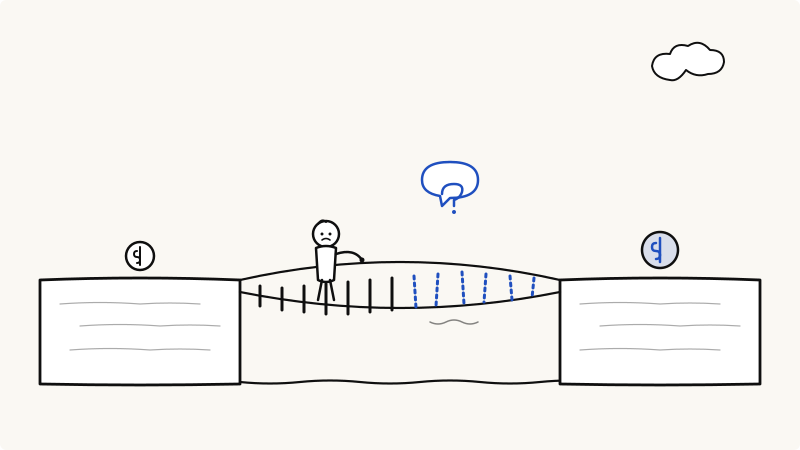
You've spent years building something real. Now you're sitting across from a buyer who says they love the business, they see the potential, and they want to acquire it. But they want to pay you in two parts: some now, some later. Conditional on performance.
Welcome to the earn-out. An earn-out can be the mechanism that gets a deal over the line at a price you're happy with. Or it can be the clause that costs you hundreds of thousands of dollars you thought you'd already earned. The difference comes down to structure, control, and whether you truly understood what you were signing.
Why they exist
Let's start with the honest reason: the buyer and the seller can't agree on price.
You think your business is worth $12 million. The buyer says $9 million. Not because they're lowballing you (though some are), but because they see risk you don't. Customer concentration. Key-person dependency. Whether your recent growth is a trend or a blip.
The earn-out bridges that gap. Here's $9 million at completion, and if the business hits these targets over the next two years, you'll receive another $3 million. In theory, everyone wins. In practice, it's significantly more complicated.
In Australian mid-market deals, most earn-outs run 12 to 36 months. Metrics are typically revenue-based (simpler, harder to manipulate) or EBITDA-based (gives the buyer more room to influence outcomes through cost allocation, which is precisely why sophisticated buyers prefer them). A tiered payment structure, where you receive partial payment for partial achievement, is almost always preferable to binary all-or-nothing thresholds.
The traps that destroy earn-out value
These are the scenarios we've seen play out after completion, and they are distressingly common.
Post-close cost loading. The buyer acquires the business, then "invests in growth" by hiring expensive staff or launching initiatives, all charged to the earn-out entity's P&L. Revenue might be growing, but EBITDA is underwater because the cost base has ballooned with expenses you never agreed to. Management fees, shared services charges, group insurance allocations, IT levies. Corporate buyers are masters at extracting value through overhead charges.
Reassigned clients. We've seen buyers move key clients from the acquired entity into a different group company. The relationship still exists, but the revenue no longer flows through the earn-out vehicle. Sometimes this is presented as "operational efficiency."
Death by delayed decision-making. A buyer who controls the business can simply slow things down. Approvals take weeks. Capital requests sit in limbo. Pricing changes get "reviewed." By the time you get permission to act, the window has closed.
The pattern is always the same: the seller carries all the risk of performance while the buyer holds all the levers that determine it.
The protections that actually matter
If you're going to accept an earn-out, here's what should be negotiated into the deal:
Operating covenants on the buyer. The buyer must operate the business in the ordinary course. No material changes to pricing, cost structures, staffing, or client arrangements without your consent during the earn-out period.
Defined calculation methodology with worked examples. What's included in revenue? What costs are allocable? How are intercompany charges treated? The more specific, the harder it is to manipulate.
Audit rights. You should have the right to access the books and appoint your own accountant to verify the numbers. Without transparency, you're trusting the buyer to mark their own homework.
Acceleration clauses. If the buyer sells the business, terminates your involvement without cause, or breaches the operating covenants, the full earn-out should accelerate and become payable immediately.
When to walk away
Walk away when the earn-out constitutes the majority of consideration and the buyer won't negotiate upward on the fixed component. Walk away when they refuse operational covenants or audit rights. Walk away when the metrics can be influenced by buyer decisions you can't control.
And critically: walk away when the buyer's attitude toward the earn-out tells you everything about how they'll behave as an owner. If they're fighting against every protection clause, if they resist transparency, that's not a partner you want to be tied to for three years.
We've seen deals where 60 percent of the purchase price was earn-out dependent. That's not a sale. That's an employment contract dressed up as a transaction.
The psychological reality
This is the part nobody discusses in deal documents. You've sold your business. Legally, it belongs to someone else. But you're still there. Still managing, still responsible for outcomes. Except now you have a boss who can override your decisions while your payment depends on the results.
Many sellers describe the earn-out period as the hardest years of their professional lives. If you're going to accept one, go in with eyes open. This is a job with a defined end date and a large bonus attached. Don't confuse it with ownership.
A lower fixed price from a buyer who operates with integrity will often deliver a better outcome than a headline price that depends on the goodwill of someone who's already shown you who they are at the negotiating table.